Choosing Pegboard Displays for global sourcing in 2026 requires more than comparing prices or counting hooks. A display must survive long-distance shipping, repeated assembly, humid storage rooms, and busy retail floors. It should also present products clearly from several viewing angles. Small details matter. Hole spacing, panel thickness, hook strength, edge protection, and replacement-part availability can change the total cost significantly.
Retail behavior expert Paco Underhill once said, “The first thing you have to understand is that people are lazy.” That observation is useful here. Shoppers should find, reach, and compare products without unnecessary effort. A well-planned Pegboard Displays system places popular items at comfortable eye and hand levels. It also leaves enough space between packages, preventing a messy wall of products. However, global buyers should question attractive samples. A perfect showroom unit may hide weak packaging or inconsistent production.
Reliable sourcing involves more than one factory visit. Request material specifications, load tests, assembly instructions, finish samples, and carton photographs. Check whether the supplier can maintain identical dimensions across production batches. Ask about recycled steel, powder-coating durability, and moisture protection. These choices affect safety, appearance, and long-term maintenance.
There is no universal best design.
A compact grocery display may need adjustable hooks and fast replenishment. A hardware retailer may require heavier brackets and reinforced panels. I have seen buyers focus too heavily on the unit price, then discover expensive replacements after installation. That mistake is avoidable, though not always. Careful supplier verification, realistic store testing, and honest evaluation of weaknesses can produce Pegboard Displays that perform reliably across markets.
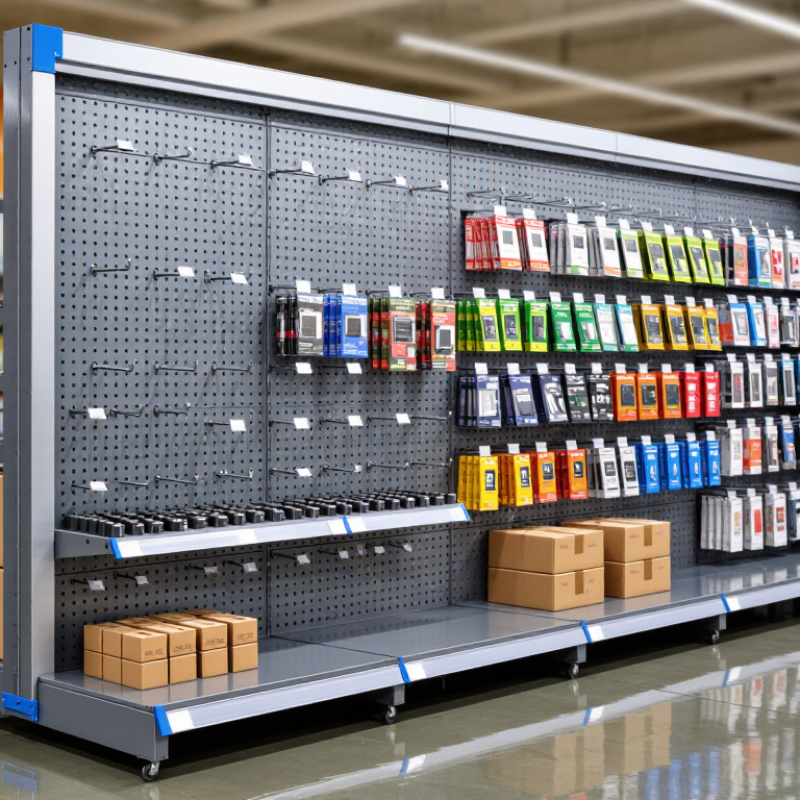
Define Pegboard Displays and Their Global Sourcing Role
Pegboard displays are modular fixtures with perforated panels that hold hooks, shelves, baskets, or small bins. Retailers use them to organize merchandise on walls, counters, and freestanding frames. Their adjustable layout makes product changes faster and reduces the need for permanent fixtures. Common materials include powder-coated steel, aluminum, wood, and molded plastic.
In global sourcing, a buyer turns this simple fixture into measurable specifications. The brief should state panel size, hole spacing, load capacity, finish, color, packaging, and assembly requirements. A supplier quote means little without these details. Requesting a sample is essential. Assemble it, load it, and check whether hooks remain stable. Inspect welds, sharp edges, coating consistency, and carton protection. Flat-pack designs may reduce freight volume, but weak packaging can create costly damage.
Supplier evaluation also requires more than a low price. Review production records, quality controls, communication speed, and replacement procedures. Ask for material documentation when required by the destination market. Small differences in hole spacing can make accessories unusable. This mistake is easy to overlook. A cheaper fixture may also feel unstable under ordinary store handling. Good sourcing balances unit cost, durability, shipping efficiency, and customer safety. The process is not perfect; specifications may need revision after real-world testing. That honest adjustment often prevents larger problems later.
Assess Product, Material, and Load-Bearing Requirements
2026 How to Choose Pegboard Displays for Global Sourcing
Assess Product, Material, and Load-Bearing Requirements
Start with the product. A small blister pack needs different support than a boxed appliance. Measure each item’s width, depth, height, and center of gravity. Include packaging, price labels, hooks, and any protective trays. Weight changes everything. Products that shift during handling may require deeper shelves or locking accessories. A practical sourcing sheet should record the heaviest unit, display quantity, and expected replenishment frequency.
Material selection affects safety, appearance, and service life. Powder-coated steel suits frequent retail handling and resists surface wear. Aluminum reduces weight but may need reinforced joints. Acrylic creates visual clarity, yet it can scratch or crack under impact. Recycled materials can support sustainability goals, but their consistency needs verification. Ask suppliers for material specifications, finish details, dimensional tolerances, and relevant test records. Do not rely on photographs alone.
Load-bearing performance deserves a real test. Check both the hook capacity and the board’s fixing points. Apply the intended load for longer than a brief showroom demonstration. Then inspect bending, loose fasteners, surface damage, and wall movement. A useful review also considers uneven loading, repeated removal, and shipping vibration. One common mistake is trusting the advertised maximum without checking installation conditions. Actual performance may fall when the wall, brackets, or fasteners differ. Require samples when possible, and document every measurement before approving a global order.
Compare Suppliers, Certifications, and Customization Options
2026 How to Choose Pegboard Displays for Global Sourcing
When comparing pegboard display suppliers, inspect more than price and catalog photos. Request samples with the exact panel thickness, hole spacing, coating, and accessories. A low quote may hide weaker edges, uneven finishes, or costly packaging. Ask about production capacity, lead times, quality checks, and replacement procedures. Factory audits, video inspections, and reference projects can reveal reliability better than polished sales language.
Certifications need careful review. Confirm whether documents apply to the finished display, its materials, or only the factory system. Depending on the destination market, request relevant material safety, fire-performance, quality-management, or recycled-content evidence. Check certificate numbers, testing dates, issuing laboratories, and product descriptions. Do not accept a generic logo as proof. I have seen paperwork look convincing while missing the actual board specification. That mistake is easy to repeat.
Customization affects both appearance and risk. Discuss colors, rounded corners, printed graphics, hook lengths, base supports, carton design, and load limits. Ask for engineering drawings before approving tooling. A small change in hole spacing can make existing accessories unusable. Test a pre-production sample with real products, not empty shelves.
Tips: Compare three suppliers using the same specification sheet. Record tolerances, sample results, certification details, and delivery promises. Leave time for one correction cycle. Perfect plans rarely survive the first sample.
Evaluate Costs, Logistics, and Import Compliance
Choosing pegboard displays for global sourcing starts with landed cost, not the factory quotation. A lower unit price may hide thicker cartons, higher dimensional weight, or costly inland delivery. UNCTAD’s Review of Maritime Transport reports that ships carry over 80% of global merchandise trade, yet port delays can still disrupt retail launch dates. Compare at least three shipping scenarios: ocean freight, consolidated cargo, and air freight for urgent replenishment. Include tooling, inspection, insurance, duties, brokerage, storage, and damage allowances.
Import compliance needs equal attention. The World Customs Organization’s Harmonized System provides the international structure for product classification, but local duty rates and documentation still vary. Confirm the correct HS code, country of origin, material description, commercial invoice, packing list, and labeling rules before production. The World Bank’s Logistics Performance Index 2023 shows wide differences between countries in customs efficiency and shipment reliability. That gap affects delivery planning. A display that arrives cheaply but waits at customs is not cheap. I have seen teams underestimate this. The spreadsheet looked complete, but origin evidence was missing.
Tips: Request a pre-production sample with final packaging. Measure carton length, width, and weight. Ask suppliers for material declarations and origin records. Build a 5–10% contingency for freight and compliance changes. Recheck assumptions quarterly; some forecasts will be wrong. Keep the mistake visible.
2026 How to Choose Pegboard Displays for Global Sourcing - Evaluate Costs, Logistics, and Import Compliance
| Display Configuration |
Typical Material |
Approx. Size
(W × H × D) |
Indicative Factory Cost
(USD/unit) |
Packed Weight
(kg/unit) |
Packed Volume
(m³/unit) |
Typical MOQ |
Indicative Production Lead Time |
Best Use Case |
Logistics and Compliance Considerations |
| Wall-Mounted Steel Pegboard |
Powder-coated cold-rolled steel |
600 × 900 × 80 mm |
$18–$32 |
4.5–7.0 |
0.045–0.070 |
100–300 |
25–40 days |
Permanent retail walls, tools, accessories, and packaged goods |
High density improves ocean freight efficiency. Confirm coating specifications, corrosion resistance, sharp-edge control, and correct steel-product HS classification with a customs broker. |
| Freestanding Double-Sided Unit |
Steel frame with steel pegboards |
900 × 1800 × 450 mm |
$95–$165 |
22–35 |
0.180–0.280 |
50–150 |
30–45 days |
High-traffic stores, exhibitions, and temporary merchandising zones |
Dimensional weight can significantly raise air-freight costs. Request knock-down packaging, assembly instructions, stability testing, and pallet dimensions before quotation. |
| Slatwall-Pegboard Combination |
MDF or plywood core with steel accessories |
1200 × 2400 × 350 mm |
$135–$240 |
30–48 |
0.300–0.460 |
50–100 |
35–50 days |
Flexible retail layouts requiring shelves, hooks, and hanging products |
Wood packaging or wood components may require ISPM 15 documentation depending on destination. Check formaldehyde-emission rules, recycled-content claims, and fire-safety requirements where applicable. |
| Perforated Steel Gondola Panel |
Heavy-gauge steel with adjustable base |
900 × 1500 × 500 mm |
$120–$210 |
35–55 |
0.240–0.380 |
50–100 |
35–55 days |
Heavy products, hardware, home-improvement goods, and warehouse retail |
Verify maximum shelf and hook loads, tipping resistance, weld quality, and packaging protection. Steel fixtures may be subject to destination-specific trade remedies or additional duties. |
| Foldable Wire Pegboard Rack |
Welded steel wire with powder coating |
600 × 1500 × 400 mm |
$42–$78 |
10–18 |
0.080–0.150 |
100–300 |
25–40 days |
Pop-up stores, seasonal campaigns, trade events, and promotional displays |
Foldable construction reduces storage and container volume. Inspect pinch points, exposed wire ends, load ratings, and packaging durability; electrical compliance is generally not applicable unless lighting is integrated. |
| Plastic Modular Pegboard |
Injection-molded PP or ABS plastic |
450 × 600 × 60 mm |
$9–$22 |
1.2–3.0 |
0.015–0.035 |
300–1000 |
30–50 days |
Lightweight displays, educational areas, cosmetics, and small accessories |
Lower freight weight but higher mold and tooling considerations. Obtain material declarations for REACH or equivalent chemical restrictions, recycling marks, and food-contact documentation if products may touch food. |
| Wooden Pegboard Display |
Birch plywood or MDF with water-based finish |
800 × 1200 × 300 mm |
$55–$110 |
12–24 |
0.120–0.220 |
100–300 |
30–45 days |
Lifestyle retail, craft products, home décor, and premium visual merchandising |
Confirm plywood or MDF emission class, timber legality requirements, moisture protection, and country-of-origin marking. Solid-wood pallets and crates normally require compliant ISPM 15 treatment and marking. |
Planning assumptions: Cost ranges are indicative 2026 factory-level estimates in USD for standard, unbranded designs and exclude tooling, samples, inland delivery, customs duties, taxes, inspection, and international freight. Final landed cost depends on destination, Incoterm, order quantity, packaging method, commodity classification, trade remedies, and applicable import regulations.
Import-compliance checklist: Confirm the HS code with the importing country’s customs authority or licensed broker; prepare commercial invoice, packing list, transport document, country-of-origin details, and any required conformity or material declarations. If the display includes lighting, batteries, electronics, or children’s-use features, additional product-safety and electrical documentation may apply.
Select, Test, and Manage the Final Supplier
2026 How to Choose Pegboard Displays for Global Sourcing
Selecting a final supplier requires more than comparing catalog prices. Start with the display’s purpose, product weight, panel size, and installation environment. A useful supplier should explain material grades, hole spacing, coating thickness, and load limits clearly. Ask for drawings with measurements, tolerances, and packaging details. Vague answers usually create expensive delays later.
Order samples from at least three qualified suppliers. Test each display with real merchandise, not empty hooks. Check panel stiffness, hook fit, edge safety, paint consistency, and assembly time. Repeat the load test after transport simulation. Use cartons with corner protection and inspect for scratches or bent parts. Our first scoring sheet looked precise, but it ignored unpacking time. That mistake changed our evaluation method.
Manage the final supplier through written specifications and approved reference samples. Record every change in materials, dimensions, finish, and packing. Request production photos before shipment, then inspect a defined quantity from each batch. A small pre-shipment inspection can reveal loose fittings or uneven holes. Keep a communication log with dates and responsible contacts. Review delivery performance, defect rates, response speed, and corrective actions every quarter. Do not select the cheapest offer automatically. Low unit cost can hide replacement work, storage problems, or missed retail deadlines. Some suppliers may perform well during sampling and weaken later. Plan a second audit. Share feedback openly, but keep acceptance standards firm.
2026 How to Choose Pegboard Displays for Global Sourcing
Select, Test, and Manage the Final Supplier with a weighted supplier-evaluation scorecard.
The chart uses a 100-point evaluation model for pegboard display suppliers. Quality and durability receive the highest weight because displays must support repeated product handling, while tooling cost, lead time, compliance, communication, and sustainability help manage sourcing risk.
FAQS
It is a modular panel with holes for hooks, shelves, baskets, or small bins. Retailers use it on walls, counters, and freestanding frames. Layouts can change quickly. Common materials include steel, aluminum, wood, and molded plastic.
State panel dimensions, thickness, hole spacing, load capacity, finish, color, packaging, and assembly needs. Include hook lengths and base support details. Small spacing errors can make accessories unusable. That detail is easy to miss.
Use the same specification sheet for at least three suppliers. Compare samples, production capacity, lead times, quality checks, and replacement procedures. Review communication speed and previous project evidence. Catalog photos are not enough.
Assemble the display before approval. Test it with real products and ordinary store handling. Check hook stability, welds, sharp edges, coating consistency, and carton protection. Samples reveal problems. Empty shelves can hide weakness.
Custom colors, rounded corners, graphics, hooks, and bases may require new tooling. Request engineering drawings before approval. Confirm every change in writing. Test a pre-production sample with final accessories. Plans often change after testing.
Calculate landed cost, not only the factory price. Include tooling, inspection, insurance, freight, duties, brokerage, storage, and damage allowances. Measure carton length, width, and weight. A cheap unit can become expensive after delivery.
Compare ocean freight, consolidated cargo, and air freight for urgent replenishment. Flat-pack designs may reduce shipping volume. Weak cartons can still cause costly damage. Add a practical contingency for freight changes and delays.
Confirm the correct product classification, country of origin, material description, commercial invoice, packing list, and labeling rules. Request material declarations and origin records before production. Customs efficiency varies by destination. Our assumptions may still be wrong.
Conclusion
Choosing Pegboard Displays for global sourcing requires a clear understanding of their purpose, structure, and commercial value. These versatile fixtures organize products efficiently in retail, trade, warehouse, and exhibition environments, while supporting flexible merchandising and space management. Buyers should first define display dimensions, hole patterns, accessory compatibility, visual requirements, material preferences, surface finishes, and expected load capacity. Steel, aluminum, wood-based panels, and composite materials each offer different advantages in durability, weight, appearance, and cost.
A reliable sourcing process also involves comparing suppliers according to manufacturing capability, quality control, certifications, customization support, and communication efficiency. Total cost should include tooling, packaging, shipping, duties, taxes, and potential inspection expenses rather than focusing only on unit price. Import requirements, labeling, packaging safety, and destination-market standards must be reviewed before placing an order. Finally, buyers should request samples, conduct load and durability tests, confirm production specifications, and establish an ongoing supplier management plan covering delivery performance, quality consistency, and future product improvements.

 DuraRacks