Folding Shelves turn unused wall space into practical storage, then fold away when the room needs to breathe. The mechanism is simple: a shelf panel attaches to a wall-mounted bracket or frame, and hinges let it move between open and folded positions. In use, the brackets support the panel and its load; when folded, the shelf takes up less room. Simple in theory. Installation, wall strength, hinge quality, and weight limits still matter.
Space is a real design consideration, though national housing data does not measure demand for folding shelves directly. The U.S. Census Bureau’s Characteristics of New Housing report lists the median floor area of new single-family homes sold in 2023 as 2,286 square feet. That figure describes new homes, not every household or storage need. Still, it helps explain why flexible storage can be useful in laundry rooms, kitchens, workshops, and compact apartments. Industrial designer Dieter Rams’s principle, “Good design is as little design as possible,” offers a useful lens for evaluating a folding shelf. Rams was not speaking specifically about shelves; the idea is to make each part useful without adding needless complexity. A shelf that folds neatly but wobbles under a light load has missed the point. Look closely at its brackets, fasteners, stated capacity, and clearance before choosing one. Small details count. In this guide, we’ll explain how Folding Shelves work, what their components do, and which practical checks help you choose and use them safely.
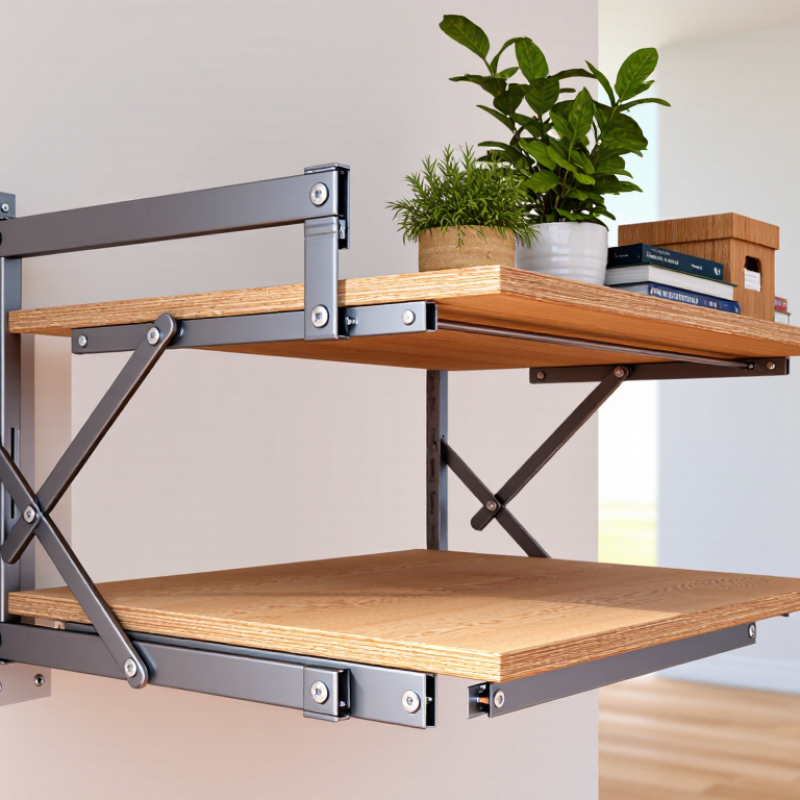
Folding shelves are wall-mounted platforms that pivot on hinges or support arms. When open, they provide a level surface for books, tools, or a laundry basket. When folded down, they sit closer to the wall and free up floor space. Their purpose is flexible storage or work space where a permanent shelf would get in the way. They are useful in compact kitchens, utility rooms, and shared work areas. Not magic, though: the wall and hardware still need to carry the load.
The U.S. Census Bureau’s 2023 Characteristics of New Housing report lists the median floor area of new single-family homes as 2,286 square feet. That figure does not measure demand for folding shelves, but it shows why making rooms serve several purposes can matter. A shelf near a washer, for example, can hold detergent while raised and fold away when someone needs room to sort clothes. Choose a model with a stated load rating, and match its fixings to the wall material. A secure installation matters more than a tidy appearance.
Tips: Check the shelf’s full open depth before mounting it. Keep hinges clear of doors and pipes, and fasten into suitable supports. Test it gently with a light load first. I’d still leave a little extra clearance; real rooms rarely match the measurements on paper.
A folding shelf usually combines a flat panel, a wall-mounted support, and hinges or pivot joints. Many models also use folding arms or locking stays to hold the shelf level when open. These parts share the load, so a sturdy panel alone does not guarantee a stable shelf. Check that the supports lock fully and that the wall fasteners suit the wall material. A small click can be reassuring, but it is not a substitute for checking the shelf’s rated capacity.
Panels may be made from solid wood, plywood, particleboard, metal, or plastic. Solid wood can be strong, but it may warp in damp conditions. Plywood is often stable, while particleboard needs protection from moisture, especially around exposed edges. Steel supports are rigid and common; aluminum is lighter but may flex more under heavy loads. Hardware quality matters, too. Loose hinges can make a shelf wobble, even when the panel looks sound. Before loading it, open and close the shelf several times, then test it with light items. That step is easy to skip. I would also recheck the screws after regular use, since vibration and repeated folding can gradually loosen them.
| Component or Feature | Purpose | Common Materials | How It Works |
|---|---|---|---|
| Shelf panel | Provides the flat surface for storing or displaying items. | Plywood, solid wood, particleboard, steel, or aluminum. | The panel rests on or attaches to folding supports when opened, then turns or folds toward the wall when stowed. |
| Hinges or pivots | Connect moving parts and guide the shelf between positions. | Usually steel or stainless steel; some light-duty designs use reinforced polymers. | A hinge rotates around a pin or joint, allowing the shelf or its supports to fold. Some designs use a continuous hinge along an edge. |
| Folding brackets or support arms | Support the shelf and help keep it level when deployed. | Steel, stainless steel, or aluminum. | Brackets commonly pivot outward into a locked or braced position. To fold the shelf, a release or latch is operated and the arms move inward. |
| Lock, latch, or release | Helps prevent accidental folding while the shelf is in use. | Often steel, stainless steel, or durable molded plastic. | Depending on the design, a pin, catch, or spring-loaded mechanism holds the support open until deliberately released. |
| Wall plate or mounting rail | Transfers the shelf’s load to the wall or supporting structure. | Steel, aluminum, or wood, depending on the shelf system. | Fasteners secure the plate or rail to suitable structural backing. Correct fasteners and installation are essential for safe support. |
| Fasteners | Attach brackets, hinges, and mounting parts to the shelf and wall. | Steel or stainless-steel screws, bolts, and anchors. | Fastener type and size should match the wall material, structural backing, and installation instructions; ordinary drywall alone may not provide adequate support. |
| Surface finish | Protects the surface and affects appearance and cleaning. | Paint, powder coating, laminate, veneer, or clear protective finish. | The finish forms a protective surface layer; suitable care depends on the underlying material and coating. |
| Operating principle | Creates a usable shelf that can be folded away to save space. | A combination of a panel, pivots, supports, and wall-mounting hardware. | Opening the shelf moves its panel and supports into a working position; folding reverses that movement. Load limits vary by design and installation, so follow the stated rating and instructions. |
A folding shelf opens by rotating its panel around a hinge, while linked arms or pivoting brackets guide its path. As it reaches horizontal, the supports lock or brace against the wall, transferring weight from the panel into the brackets and fasteners. Keep the load close to the wall; a heavy object at the front edge creates greater leverage on the hinges. Clicks matter. They may signal that a latch has engaged, but they do not prove the shelf is correctly installed.
When folding it down, lift the panel slightly to release the catch, then guide it toward the wall rather than letting it drop. Check hinge screws, bracket alignment, and the wall surface regularly. A loose fastener can make a shelf sag before it fails. ANSI/BIFMA X5.9-2019 evaluates storage units through strength, stability, and durability testing; those industry tests offer useful context, but the shelf’s own rated capacity remains the limit to follow. I would not treat a smooth opening as proof of safety. A shelf can feel fine when empty, then shift under uneven weight.
Folding shelves use hinges or pivoting brackets to move from a compact, upright position to a usable surface. Common types include drop-leaf shelves, which fold down from a wall-mounted panel, and bracket-supported shelves, whose arms swing out beneath the board. Multi-panel designs can create a wider work surface, but their extra hinges need careful alignment. Not always simple.
Mounting depends on the wall and expected load. For drywall, fasten into wall studs whenever possible; masonry usually needs anchors rated for the material. A continuous mounting rail can spread force across several fixing points. The ANSI/BIFMA X5.9-2019 standard evaluates storage-unit strength, stability, and durability, but it does not give every shelf installation a universal safe-load rating. Follow the shelf maker’s stated capacity, and account for the weight of both the shelf and its contents. A tidy finish can hide weak backing. That detail is easy to miss.
Tips: Use a level, mark the hinge line, and test the shelf empty before loading it. Keep heavy items near the wall, not at the outer edge. Measure twice. A little extra clearance around the folded shelf prevents rubbing, though real walls are rarely perfectly square.
Folding shelves attach to a wall or frame and pivot between a usable position and a folded position. Brackets, legs, or hinges support the shelf when open; the specific hardware depends on the design and mounting surface.
How to read the chart: These are representative hardware counts, not product standards or load ratings. Actual designs vary. For safe mounting, fasten into suitable structural supports or use anchors rated for the wall material; never rely on unsupported drywall alone.
Folding shelves use hinges or folding brackets to open into a usable storage surface and collapse when space is needed. They suit laundry rooms, workshops, small kitchens, market stalls, and temporary work areas. A shelf can hold detergent bottles, hand tools, or labeled boxes, then fold flat against a wall or frame. Handy, but only when installed for that purpose. Check whether the model is freestanding or designed for wall mounting; their supports and safe loading methods differ.
Check the stated weight limit before loading, and spread items across the shelf rather than stacking everything at one edge. Lock braces fully, use the specified wall fixings, and place freestanding units on a level floor. Keep fingers clear of hinges while opening or folding. Never climb on a shelf, even briefly.
Small details matter. The 2023 Liberty Mutual Workplace Safety Index estimated that overexertion involving outside sources cost U.S. employers $12.8 billion in direct costs. This is not a folding-shelf injury estimate, but it underlines the value of sensible handling: store heavy items low, lift close to your body, and avoid awkward reaches.
A capacity label can be easy to miss, and load ratings may assume even distribution. Check the instructions rather than guessing.
Most have a flat panel, wall supports, and hinges or pivot joints. Folding arms may help hold the shelf level. A strong-looking panel alone is not enough.
Shelves may use solid wood, plywood, particleboard, metal, or plastic. Plywood is often stable. Particleboard edges need protection from moisture.
Open and close the shelf several times. Check that the supports lock fully, then test with light items. Listen for wobbling, not just a reassuring click.
On drywall, fasten into wall studs when possible. For masonry, use anchors suited to the material. A level helps keep the hinge line straight.
Follow the stated capacity for your shelf and mounting setup. Include the shelf’s own weight. A clean finish can hide weak wall backing.
Keep them near the wall rather than at the outer edge. That reduces strain on the supports. Small detail, big difference.
Leave a little clearance around the folded shelf. Measure twice, though walls are rarely perfectly square. I sometimes forget that part.
No. A storage-unit strength standard does not set one universal safe load for every installation. Check the shelf capacity and wall fasteners, then recheck screws after regular use. They can loosen.
Folding Shelves are space-saving storage surfaces designed to fold flat against a wall or frame when they are not in use. They typically consist of a shelf panel, hinges or pivot points, and supporting brackets or arms. Common materials include wood, metal, and durable engineered panels, chosen according to the shelf’s intended load and setting. When opened, the panel rotates into a horizontal position, while brackets, locking supports, or cables help keep it steady. To fold it away, the user releases or repositions the support mechanism and lowers the panel carefully.
Folding shelves come in wall-mounted and frame-mounted styles, with options such as fixed hinges, folding brackets, and adjustable supports. They are useful in kitchens, workshops, laundry areas, small rooms, and other places where flexible storage is helpful. For safe use, install the shelf on a suitable, secure surface, follow the hardware instructions, and check that all supports are engaged before placing items on it. Keep within its stated weight limit, distribute loads evenly, and keep fingers clear of moving joints while folding.

DuraRacks